







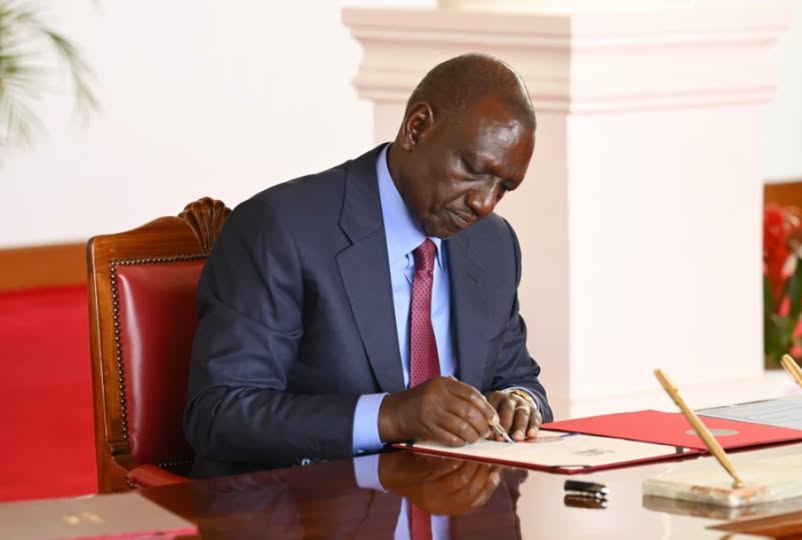

President William Ruto has on Tuesday assented to four Bills into law as part of efforts to strengthen governance and improve service delivery in the country. The four pieces of legislation are the Public Finance Management Amendment Bill, Air Passenger Service Charge Amendment Bill, Kenya National Council for Population and Development Bill, and Trust Administration Bill.
Public Finance Management Amendment Bill
The Public Finance Management Amendment Bill seeks to enhance accountability and oversight in the management of public funds. The legislation establishes a standardised mechanism through which grants and allocations can be channelled to county governments without unnecessary bureaucratic delays. It also seeks to streamline legal provisions governing funds allocated through intergovernmental agreements, making it easier to track the money and safeguard public resources against administrative leakages.
The law further introduces penalties for accounting officers who fail to implement resolutions issued by parliamentary or county assembly committees concerning reports by the Controller of Budget on the implementation of national and county government budgets, as well as audit reports issued by the Auditor-General. The provision was previously not contained in the Public Finance Management Act.
Air Passenger Service Charge Amendment Bill
The Air Passenger Service Charge Amendment Bill provides for streamlined administration, management and allocation of revenue collected from air passengers. The changes are expected to facilitate more effective utilisation of the revenue to support Kenya’s aviation and tourism sectors. Passengers currently pay Ksh600 for domestic flights and Ksh6,500 (US$50) for international flights departing Kenya.
The revised charges took effect after President Ruto assented to the Air Passenger Service Charge (Amendment) Act on October 15, 2025. Before the increase, passengers paid Ksh500 for domestic flights and Ksh5,100 (US$40) for international departures.
Revenue collected through the charges is shared among key government agencies involved in aviation infrastructure, safety and tourism, including the Kenya Airports Authority (KAA), Kenya Civil Aviation Authority (KCAA), Kenya Meteorological Service Authority and Tourism Fund.
Kenya National Council for Population and Development Bill
The Kenya National Council for Population and Development Bill formally establishes the National Council for Population and Development in law. The move is expected to strengthen the Council’s ability to set standards, coordinate and monitor population programmes. Previously, the Council operated under an Executive Order, which limited its legal capacity to effectively establish standards and coordinate population and development programmes.
The Council is mandated to undertake research and analysis on population matters and develop, publish and disseminate policies related to population and development. It is also responsible for planning and publishing population and development materials, identifying emerging population issues and advising both national and county governments on matters that may not be adequately addressed. In addition, the Council will establish standards for population programmes across the country.
Trust Administration Bill
The Trust Administration Bill brings together the Trustees (Perpetual Succession) Act (Cap. 164) and the Trustee Act (Cap. 167) in an effort to make the law governing trusts clearer, more consistent and easier to access. The Trustees (Perpetual Succession) Act, enacted in 1923, allows families, religious organisations and charitable institutions to appoint trustees as incorporated bodies to hold, acquire and manage property on their behalf.
Meanwhile, the Trustee Act, enacted in 1929, provides for the appointment, powers and responsibilities of trustees acting as unincorporated individuals in managing property held in trust. The consolidation of the two laws is intended to improve transparency in trust administration by introducing a formal framework for the registration and incorporation of trusts.
It will also require the disclosure and maintenance of trust-related information and establish a centralised repository of information on trusts. The four laws are expected to strengthen accountability, improve the management of public resources and enhance the legal frameworks governing key areas of governance and service delivery in Kenya.
