



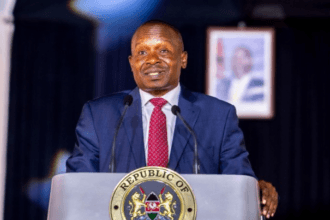


Wiper Patriotic Front leader Kalonzo Musyoka has pushed back strongly against remarks made by President William Ruto questioning infrastructure development in his home region, escalating a war of words between the two leaders over roads, leadership experience, and national development priorities. Speaking during a public engagement, Kalonzo accused President Ruto of using a recent visit to Kiambu to attack his political record instead of focusing on policy and governance issues.
“I Became the Topic, Not the Agenda”
Kalonzo said he was surprised that the Head of State chose to single him out during the Kiambu visit, rather than outlining his development agenda to residents. According to the former Vice President, Ruto’s remarks misrepresented both his years in public service and his contribution to infrastructure development. Kalonzo clarified that his time in leadership spans four decades, not five as alleged by the President, and insisted those years were marked by substantive experience and tangible development outcomes.
Defending His Infrastructure Record
The Wiper leader went on to defend his legacy, particularly in the Ukambani region, saying he played a direct role in delivering major road projects during his tenure in government. He pointed to the strategic highway linking Kibwezi, Mutomo, Kitui, Mwingi, Tseikuru and Maua, describing it as a critical transport corridor that connects northern Kenya and Ethiopia to the Port of Mombasa. Kalonzo noted that the project was initiated when he served as Vice President and involved the engagement of a Chinese contractor, Sinohydro, to execute the works. He argued that such projects demonstrate long-term planning and meaningful contribution to national connectivity.
Ruto’s Sharp Criticism
President Ruto, while addressing residents on Sunday, took aim at Kalonzo, branding him a habitual critic of government initiatives and dismissing his opposition to the administration’s development agenda. The President questioned Kalonzo’s credibility on matters of development, arguing that despite decades in politics, infrastructure around his rural home remains undeveloped. Ruto suggested that leaders who have not delivered tangible projects at the grassroots level lack the moral authority to challenge national development plans. He framed the criticism as evidence of a lack of vision and planning by the opposition.
Clash Over Development Philosophy
At the center of the exchange is President Ruto’s ambitious road construction plan. The Head of State reaffirmed his administration’s commitment to expanding Kenya’s road network, stating that the government aims to construct 28,000 kilometres of roads by 2032. Ruto defended the feasibility of the plan, drawing comparisons to the previous administration, which oversaw the construction of approximately 10,000 kilometres of roads over a decade. According to the President, expanded road infrastructure is essential for unlocking economic growth, improving market access, and boosting regional integration.
A Political Debate With Broader Implications
The public spat between Ruto and Kalonzo highlights a deeper political divide over development records, accountability, and the realism of large-scale government promises. As the government rolls out its ambitious infrastructure agenda, opposition leaders are increasingly scrutinizing implementation capacity and track records, while the administration continues to push back against critics it views as obstructionist. With road development remaining a key political issue, the exchange is likely to resonate with voters as the country debates not just kilometres of tarmac, but the credibility and vision of its leaders.
