






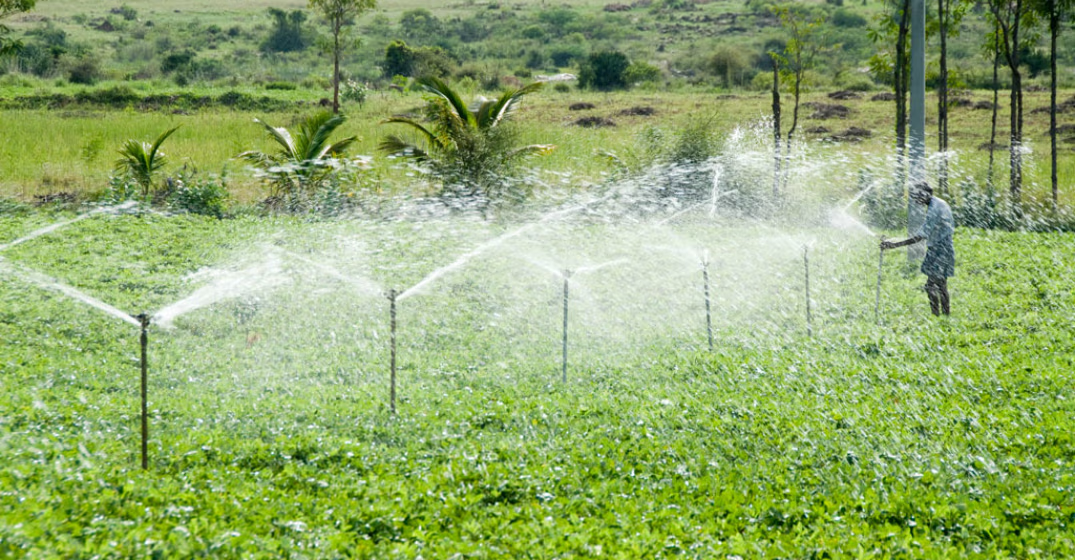

The Government is seeking increased private sector investment to help finance 61 per cent of the Ksh598 billion National Irrigation Sector Investment Plan (NISIP) 2025–2035, which seeks to expand irrigation and strengthen food security across Kenya. Water, Sanitation and Irrigation Cabinet Secretary Eric Muriithi said the Government cannot rely solely on public funds to finance the ambitious 10-year programme.
The plan targets the expansion of irrigated land to more than 1.5 million acres, with the Government looking to mobilise investment from commercial banks, development partners, equipment manufacturers, suppliers and agribusinesses. Speaking in Nairobi during the Eastern and Southern Africa Private Sector Forum on Irrigation, Muriithi said private sector participation would be critical to achieving the objectives of the investment plan. He called on stakeholders across the irrigation value chain to work together under a coordinated framework to increase investment and improve outcomes for farmers.
Government Seeks New Financing for Irrigation
The forum brought together representatives from 39 governments and private sector organisations to discuss challenges and risks that continue to limit private investment in irrigation. The Government is working with the World Bank and International Finance Corporation (IFC) through the Kenya Resilient Irrigation for a Sustainable Economy (K-RISE) programme to develop financing solutions for the sector.
World Bank Eastern and Southern Africa Division Director Qimiao Fan said K-RISE would help address some of the financial barriers that have made it difficult for private investors to participate in irrigation projects. The programme is expected to support job creation while improving opportunities for farmers to increase agricultural production and incomes.
Three Financing Tools to Support Investment
K-RISE will use three financing mechanisms designed to attract private capital into irrigation. The Results-Based Finance Facility will provide rebates and grants to irrigation equipment dealers based on verified equipment sales and successful installations.
The Risk Sharing Facility will offer first-loss and partial credit guarantees to financial institutions, including banks, microfinance institutions and SACCOs providing loans specifically for irrigation. The third mechanism, known as the Patient Capital Facility, will support suppliers and financiers who require longer repayment periods to recover investments made in irrigation projects. The financing instruments are intended to reduce investment risks while making irrigation-related lending more accessible to farmers and businesses.
10 Irrigation Schemes Selected for Pilot Programme
The Government has selected 10 irrigation schemes for an initial pilot programme covering approximately 14,819 acres and 52,115 farmers. The selected schemes support the production of a range of crops, including rice, maize, horticultural crops, vegetables, pulses, potatoes, onions and avocados.
The Government also plans to strengthen farmer cooperatives and improve connections between farmers and markets.Through stronger links with processors, exporters and other buyers, farmers are expected to gain better access to markets while improving the returns generated from their agricultural produce. The wider irrigation investment plan is aimed at increasing agricultural productivity, supporting food security and creating opportunities for private investment across Kenya’s agricultural sector.
