






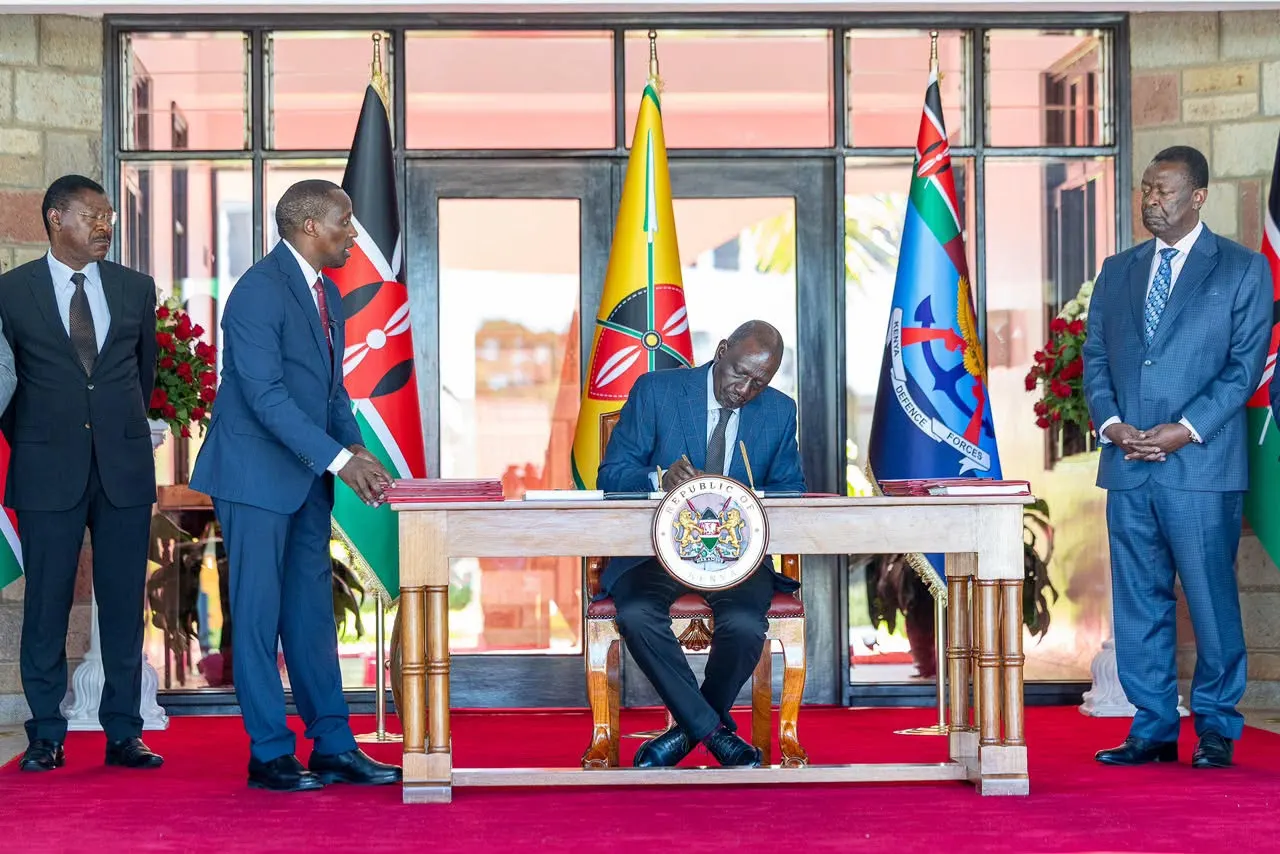
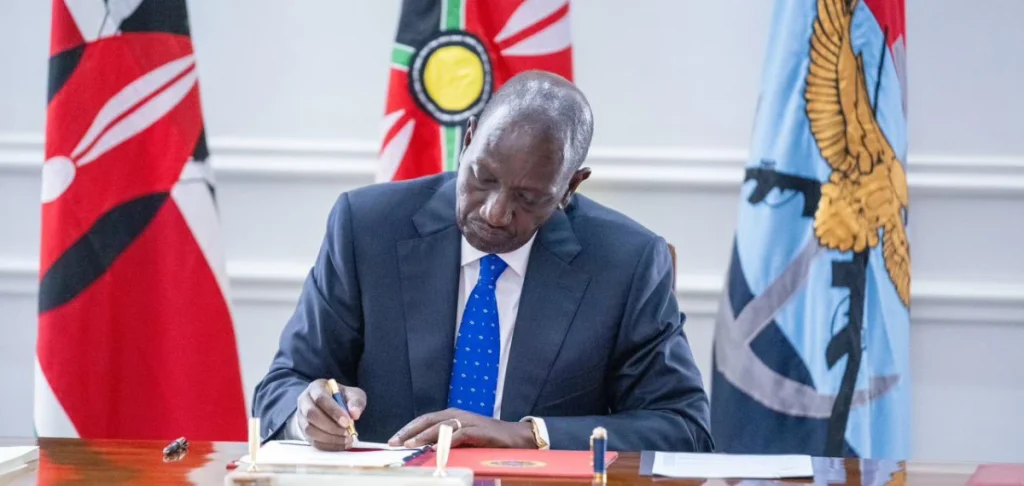
President William Ruto has signed the Tax Laws Amendment Bill, 2026, and the Kenya Revenue Authority (Amendment) Bill, 2026, into law, extending the reduced Value Added Tax (VAT) rate on petroleum products and introducing changes to construction-related taxes and the management of the tax authority.
The President assented to the two Bills at Eldoret State Lodge in Uasin Gishu County on Friday, October 16, 2026, following their approval by the National Assembly. The new legislation seeks to cushion consumers against rising fuel costs, adjust excise duty on selected construction materials and strengthen coordination between the Kenya Revenue Authority (KRA) and other government agencies.
Reduced VAT on Petrol, Diesel and Paraffin Extended
Under the Tax Laws Amendment Act, the eight per cent VAT rate on petrol, diesel and paraffin will remain in place for an initial period of 90 days. The law also allows the Cabinet Secretary for the National Treasury to extend the period by a further 90 days through a notice published in the Kenya Gazette. Deputy Chief of Staff Josephat Nanok said the measure was introduced to protect Kenyan consumers and businesses from the impact of disruptions in the international oil market associated with the crisis in the Middle East.
Nanok explained that the reduced VAT rate had been incorporated into fuel price calculations following consultations involving the Energy and Petroleum Regulatory Authority (EPRA) and the Ministry of Energy. He noted that fuel prices would have been higher had the eight per cent rate not been factored into the calculations announced by EPRA. The extension is expected to provide temporary relief to motorists, households and businesses that depend on petroleum products for transport, production and other daily activities.
New Excise Duty Rates for Construction Materials
The Tax Laws Amendment Act also introduces changes to the taxation of selected construction materials, including tiles and ceramic sanitary products. Under the revised provisions, excise duty on tiles will be charged at KSh 400 per square metre, replacing the previous weight-based method of taxation. The legislation further reduces excise duty on ceramic sanitary ware, including sinks, from KSh 50 to KSh 30 per kilogramme.
Additionally, the law revises the description of imported flat glass to bring it into line with East African Community protocols. The changes are intended to adjust the tax treatment of these products and could influence costs within the construction and building materials sector.
KRA Amendment Changes Board Composition
The President also signed the Kenya Revenue Authority (Amendment) Bill, 2026, which revises provisions governing the composition and membership of the authority’s board. Among the changes is the removal of the designation of certain government officials as ex-officio members under the relevant provisions. The amendment also provides for the Managing Director of the Kenya Ports Authority (KPA) to sit on the KRA board.
Nanok said the inclusion of the KPA managing director would strengthen coordination between the two institutions, particularly on matters involving revenue collection and port operations. He explained that the arrangement would help ensure that decisions made by KRA take into account activities at the ports, where imported goods are processed and relevant taxes collected.
KRA to Receive at Least 2% of Estimated Annual Revenue
The amendment further provides for KRA to receive funding equivalent to at least two per cent of its estimated annual revenue collections, as reflected in the government’s financial estimates. It also updates the list of laws administered by the tax authority. The funding provision is intended to support the authority’s operations and revenue collection responsibilities, while the revised governance arrangements seek to improve coordination with other government institutions.
What the New Tax Laws Mean for Kenyans
The two laws introduce changes affecting fuel taxation, construction materials and the administration of tax collection. The continuation of the eight per cent VAT rate on petroleum products is expected to offer temporary relief from fuel price pressures, while the revised excise duties alter the tax treatment of selected building materials. Meanwhile, the changes to KRA’s board composition and funding arrangements are aimed at strengthening the authority’s operations and its working relationship with KPA.
The impact of the measures on consumers and businesses will depend on how they are implemented, developments in international oil markets and the resulting movement in fuel and construction costs. The legislation marks a further adjustment to Kenya’s tax framework as the government seeks to balance revenue collection with efforts to manage the cost of living.
