





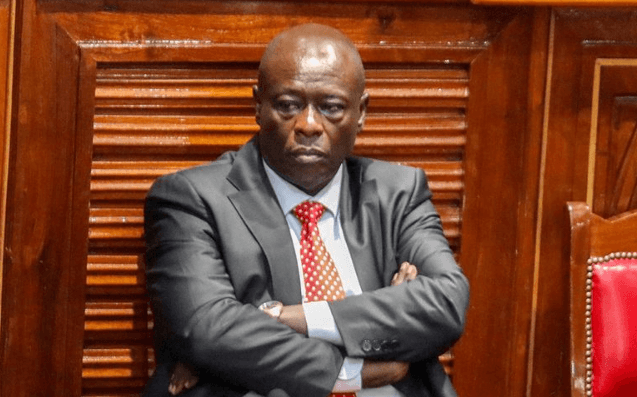
Former Deputy President Rigathi Gachagua was not present in court on Monday as a three-judge bench issued its much-anticipated ruling on petitions challenging his impeachment. The bench, made up of Justices Eric Ogola, Anthony Mrima and Frida Mugambi, dismissed an application seeking to delay the judgment and proceeded with the ruling as scheduled. The adjournment request had been filed by lawyer Harrison Kinyanjui on behalf of petitioner Enock Aura, whose case was among several consolidated petitions contesting Gachagua’s removal from office.
The decision marks a significant milestone in a prolonged legal battle that began after Gachagua’s impeachment in October 2024. His removal made history as he became the first Deputy President in Kenya to be ousted through the constitutional impeachment process. The National Assembly voted to impeach him on October 8, 2024, and the Senate upheld the decision on October 17 after reviewing 11 charges. These accusations were broadly categorised into constitutional violations, alleged criminal conduct under national and international law, and gross misconduct. Under the constitutional violations, lawmakers accused Gachagua of breaching provisions related to leadership, integrity, accountability and the rule of law, as well as failing to uphold the responsibilities of the Deputy President’s office.
The second category involved alleged offences under various laws, including claims of promoting ethnic division contrary to the National Cohesion and Integration Act. He also faced allegations of corruption, economic crimes and possession of unexplained wealth reportedly amounting to Sh5.2 billion. Additionally, he was accused of misleading the public in violation of existing legal frameworks. The third category focused on claims of gross misconduct, including accusations of promoting divisive politics, undermining senior government institutions and engaging in conduct deemed incompatible with his office. He was also accused of insubordination and mistreatment of public officials.
While the National Assembly approved all 11 charges, the Senate upheld five, effectively sealing his removal. Among the upheld charges were those linked to remarks considered to incite ethnic division, attacks on the Judiciary and alleged violations of the National Cohesion and Integration Act. Senators also found fault in his conduct toward the National Intelligence Service, which they deemed inappropriate for a holder of his office.
In his court challenge, Gachagua argued that he was denied a fair hearing, stating that he was hospitalised during the Senate proceedings and therefore unable to fully defend himself. However, he later dropped his bid to be reinstated and instead shifted focus to seeking compensation and restoration of benefits.
The former Deputy President is now seeking over Sh80 million in compensation, including salary and gratuity for the remainder of his term, a retirement package, a monthly pension estimated at about Sh980,000 and comprehensive medical cover. He is also requesting reinstatement of privileges typically granted to former office holders, such as official vehicles, security detail, VIP airport access and diplomatic passports.
The court’s decision is expected to have far-reaching implications on how impeachment processes are conducted in Kenya, the rights of public officials facing removal from office and the benefits due to former senior state officers.
