








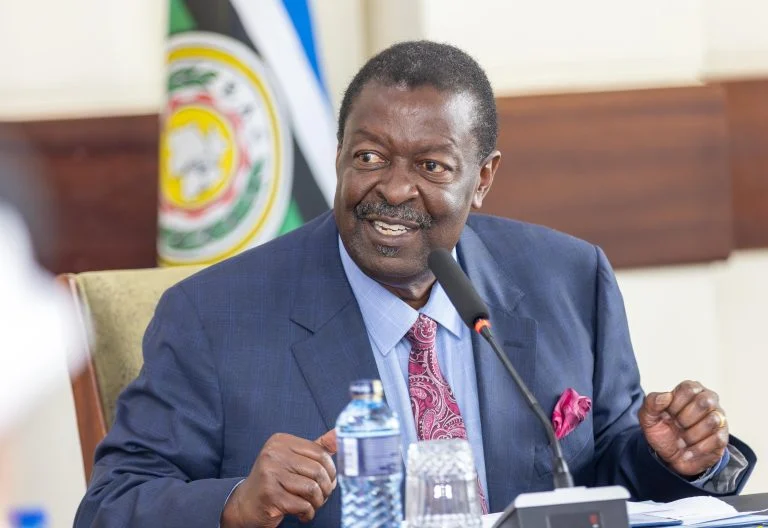
Prime Cabinet Secretary Musalia Mudavadi has urged Kenyans living in other East African Community (EAC) member states to comply with the immigration and business regulations of their host countries. Mudavadi said Kenya remains committed to the principles of mutual respect within the EAC, noting that citizens of partner states must observe the laws governing entry, residence and provision of services in member countries.
His remarks come after President William Ruto directed foreign nationals operating small-scale businesses in Kenya to obtain the necessary permits and documentation. Mudavadi said the government’s move should not be viewed as an attempt to discriminate against foreigners, but rather as an effort to ensure that all people conducting business in Kenya operate within the law and contribute fairly to the economy.
Speaking during a diplomatic engagement in Nairobi on Thursday, Mudavadi said citizens from EAC partner states are expected to follow the laws of the countries where they live and work. He added that Kenya remains open to foreign nationals who wish to conduct business in the country, provided they meet the relevant immigration and regulatory requirements.
According to Mudavadi, the government’s approach is focused on regulation rather than discrimination, with the aim of balancing regional integration with Kenya’s domestic laws. He said restrictions affecting small-scale trade and informal retail were intended to protect vulnerable sections of the local economy, promote fair competition and safeguard the livelihoods of Kenyan citizens.
Mudavadi maintained that Kenya had not imposed a blanket prohibition on foreigners engaging in small-scale businesses. Instead, the government is seeking to ensure that their participation complies with EAC commitments and Kenyan law. President Ruto’s September 2 directive has, however, caused concern among some foreign nationals in the country, with several visiting their respective embassies to seek assistance in regularising their documentation.
Some Burundian nationals who spoke to Citizen Digital expressed concern over the directive, saying they had limited time to secure the required permits and other documents. The President subsequently provided a 90-day period for an orderly regularisation process, giving affected foreign nationals an opportunity to formalise their stay and business operations in Kenya.
Ruto has emphasised that anyone conducting business in Kenya must meet immigration, work permit, registration and licensing requirements. The Head of State has also reaffirmed Kenya’s commitment to EAC integration, saying his administration will continue supporting the free movement of people, labour, services and capital within the applicable legal frameworks, including the African Continental Free Trade Area (AfCFTA).
