





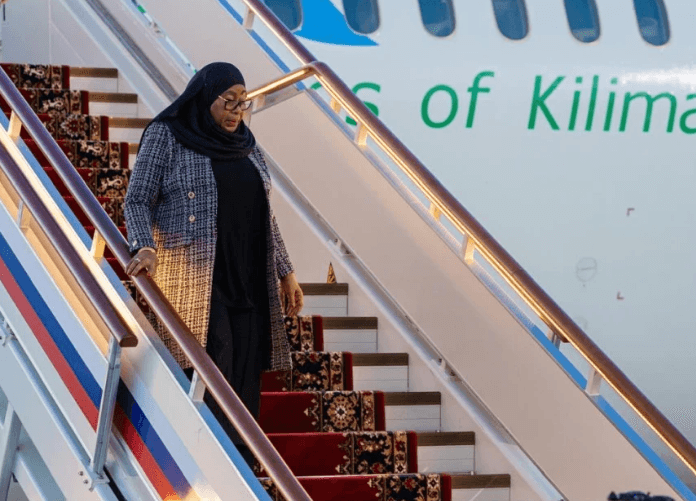
Tanzanian President Samia Suluhu Hassan has embarked on a three-day state visit to Russia, where she is expected to hold talks with President Vladimir Putin. The visit comes at a time when Tanzania is facing mounting criticism from Western nations over its recent political climate. Relations between Tanzania and Western countries have become strained following allegations by diplomats and human rights organizations accusing the government of severe human rights violations. These include claims of deadly force used during the October elections, as well as reported abductions and killings of government critics in the lead-up to the polls.
The United States has already indicated that it is reassessing its relationship with Tanzania. In a recent move, Washington imposed sanctions on a senior Tanzanian police officer linked to the alleged torture of two prominent activists. In contrast, Russia has taken a more supportive stance. President Putin was among the first global leaders to congratulate President Hassan following her overwhelming election victory. Since then, ties between the two countries have steadily improved.
Earlier this year, the two nations established a joint business council to strengthen economic cooperation. Additionally, Air Tanzania recently announced plans to launch direct flights between Dar es Salaam and Moscow before the end of the year, signaling growing connectivity and partnership. President Hassan remains firm in her government’s approach to handling dissent, previously making strong remarks against activists and protesters. During her visit, she is accompanied by a delegation of business leaders, with the aim of securing agreements in key sectors such as trade, tourism, and mineral resources.
This marks a historic moment, as it is the first official visit by a Tanzanian president to Russia since the late founding leader Julius Nyerere traveled there in 1969. Despite warming ties, economic cooperation between the two countries remains relatively modest, with annual trade estimated at just over $300 million. One of the notable long-standing projects under discussion is a proposed uranium mining venture, which has yet to materialize.
Analysts suggest that Russia may benefit diplomatically from closer ties with Tanzania, particularly in gaining support or neutrality in international forums such as the United Nations, especially concerning the ongoing conflict in Ukraine. Meanwhile, concerns persist over accountability for last year’s election violence. A government report indicated that more than 500 people lost their lives during the unrest, but it did not assign responsibility, raising further questions from observers.
President Hassan’s visit to Russia highlights a shifting diplomatic landscape as Tanzania seeks to strengthen alternative global partnerships amid growing scrutiny from Western nations. The outcomes of this trip could shape the country’s economic and political direction in the months ahead.
